
What Is Central Daylight Time (CDT) and How Does It Work?
Introduction
Time zones help organize daily life across different regions of the world. Without them, coordinating meetings, travel schedules, online events, and business operations would be extremely confusing. One of the most commonly referenced time zones in North America is Central Daylight Time, which plays an important role during the warmer months of the year when daylight saving adjustments are active.
Central Daylight Time is not a permanent time zone. Instead, it is a seasonal shift that moves clocks forward to make better use of natural daylight in the evening. This adjustment affects millions of people in different countries and is especially important for communication between regions that follow different time standards.
Understanding how this time zone works helps avoid confusion in scheduling, especially for businesses, travelers, and anyone working across international boundaries.
What Is Central Daylight Time?
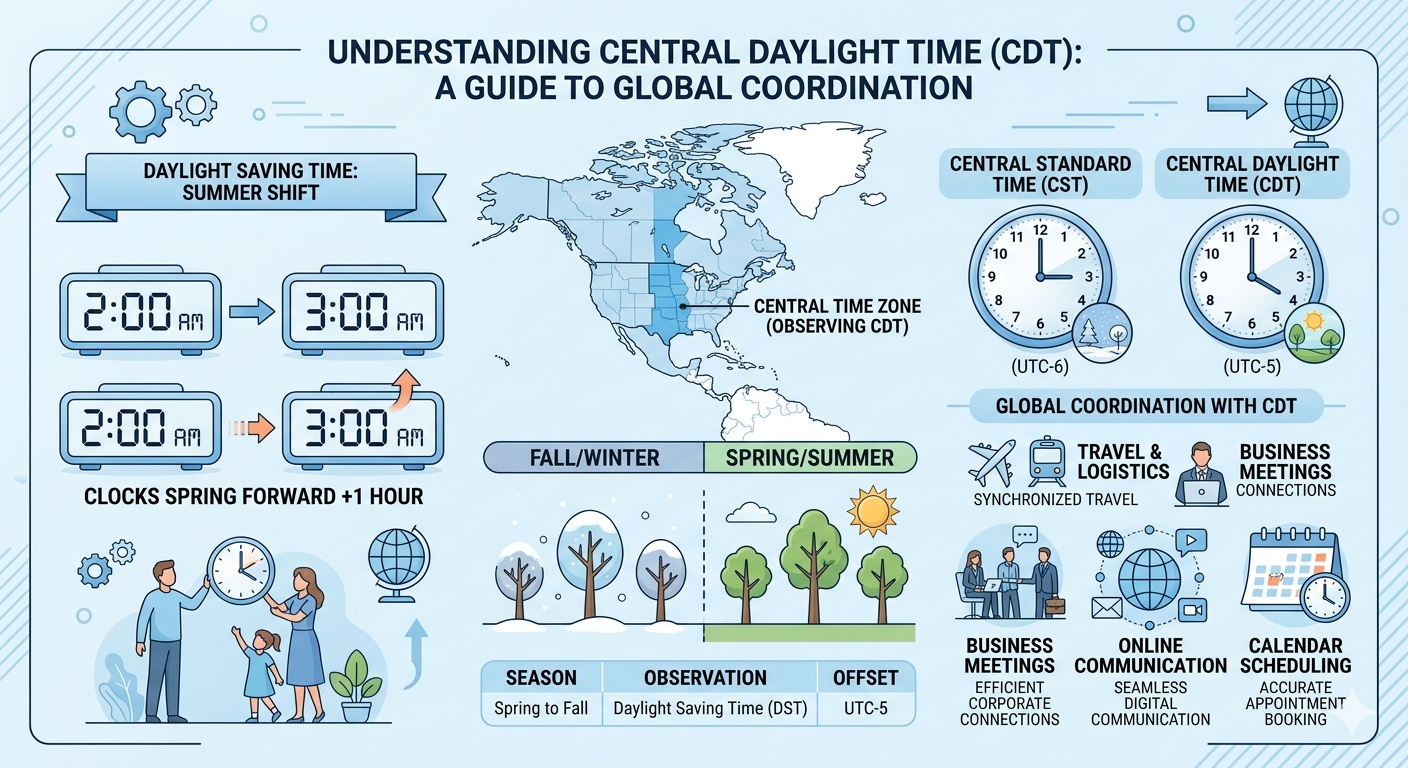
Central Daylight Time is a daylight saving time zone used in parts of North America during spring and summer months. It is part of the broader Central Time Zone system and represents a one-hour shift forward from standard time.
Central Daylight Time is typically used when clocks are set one hour ahead of Central Standard Time. This shift is designed to extend evening daylight, allowing people to enjoy more daylight hours after work or school.
In simple terms:
- Standard time is used in the winter months
- Daylight time is used in the warmer months
- Clocks move forward by one hour in spring and move back again in autumn
This seasonal adjustment is widely practiced in many regions that experience significant differences in daylight hours between seasons.
How Central Daylight Time Works
The core idea behind Central Daylight Time is daylight saving. When the time shifts in spring, clocks are moved forward by one hour. This means that mornings become slightly darker, but evenings stay lighter for longer.
UTC Offset Explained
During Central Daylight Time, the offset from Coordinated Universal Time (UTC) is minus five hours (UTC-5). This is important for international communication because UTC is the global reference point used to standardize time across the world.
When daylight saving ends, the region switches back to Central Standard Time, which is UTC-6.
The Purpose of the Shift
The main reason for this adjustment is energy optimization and lifestyle convenience. By shifting daylight into the evening hours:
- People can use more natural light after work
- Outdoor activities become more accessible in the evening
- There is often reduced reliance on artificial lighting
While the benefits are still debated, many regions continue to use this system due to tradition and coordination needs.
Regions That Use Central Daylight Time
Central Daylight Time is used in several countries, mainly in North America. The largest usage is in the United States, where many central states follow this schedule.
In the United States, areas that typically observe this time include:
- Illinois
- Texas
- Missouri
- Minnesota
- Wisconsin
- Parts of several other central states
Canada also follows a similar structure in its central regions, while some areas of Mexico observe comparable time shifts depending on location and policy.
However, not all places in these regions follow daylight saving rules. Some areas choose to remain on standard time throughout the year, which can sometimes create confusion when planning cross-border communication.
Difference Between CDT and CST
One of the most common points of confusion is the difference between Central Daylight Time and Central Standard Time.
Central Standard Time (CST)
- Used during fall and winter
- UTC-6
- Standard time without daylight saving adjustment
Central Daylight Time (CDT)
- Used during spring and summer
- UTC-5
- One hour ahead of standard time
The one-hour difference may seem small, but it has a major impact on scheduling, especially for international calls, flights, and digital events.
For example, a meeting set at 3:00 PM CST would be 4:00 PM CDT during daylight saving months.
How to Convert CDT to Other Time Zones
Understanding conversions is essential when working with global teams or scheduling across regions.
Here are a few simple examples:
- Eastern Time (ET) is one hour ahead of CDT
- Mountain Time (MT) is one hour behind CDT
- Pacific Time (PT) is two hours behind CDT
- UTC is five hours ahead of CDT
So if it is 2:00 PM in Central Daylight Time:
- It would be 3:00 PM in New York
- 1:00 PM in Denver
- 12:00 PM in Los Angeles
- 7:00 PM in UTC
These differences are crucial for avoiding missed meetings or incorrect scheduling, especially in remote work environments.
Why Central Daylight Time Matters Today
In today’s connected world, time coordination is more important than ever. People attend virtual meetings, manage international projects, and travel frequently across different regions. Even a one-hour misunderstanding can lead to missed opportunities or scheduling conflicts.
Central Daylight Time is especially relevant for:
- Businesses coordinating across multiple time zones
- Airlines and travel scheduling systems
- Online gaming and streaming events
- Remote teams working across continents
As digital communication continues to grow, awareness of time zone differences becomes a basic but essential skill.
When Does CDT Start and End?
The switch between standard time and daylight time follows a predictable pattern each year.
- It begins in spring when clocks move forward by one hour
- It ends in fall when clocks move back by one hour
This change is often referred to as “spring forward” and “fall back.” The exact dates vary slightly each year but generally follow a consistent schedule across regions that observe daylight saving time.
Checking the Current CDT Time
Many people search for the current local time when scheduling meetings or planning travel. Since CDT changes depending on the season, it is important to verify it before making decisions.
When someone looks up “CDT time now”, they are usually trying to confirm the exact current time in Central Daylight Time compared to their own location.
Because CDT is dynamic, it always depends on whether daylight saving time is active at that moment. This makes real-time checking especially important for international coordination.
Common Confusion About CDT
Despite being widely used, Central Daylight Time often creates confusion for several reasons:
- Not all regions observe daylight saving time
- The switch dates vary slightly by year
- It is easy to mix up CST and CDT
- Global audiences may not be familiar with US time zones
To avoid mistakes, many professionals rely on digital calendars that automatically adjust time zones. However, understanding the basics still helps in verifying accuracy.
Conclusion
Central Daylight Time plays an important role in organizing schedules during the warmer months in many parts of North America. By shifting clocks forward, it helps extend evening daylight and supports daily activities in a more natural light cycle.
Understanding how it works, how it differs from standard time, and how to convert it into other time zones can make communication and planning much more efficient. Whether for business, travel, or personal coordination, being aware of these time changes ensures smoother interactions across regions.
As global connectivity continues to grow, knowing how time zones function remains a simple but powerful advantage in everyday life.

Deepak Sharma
Namaste! I’m Deepak Sharma, the creative mind behind SocialFunda, your go-to hub for Facebook bios, captivating captions, Instagram bios, and a treasure trove of Hindi Shayari. As a digital enthusiast, I am passionate about curating content that adds a touch of flair to your online presence.